A Naturalist's Record of an Investigation from First Principles
to the Frontier of Quantum Gravity.
Vol. IINo. IMay MMXXVI
Lead Story · Vol. II, No. I · The Frontier
A Non-Physicist and an A.I. Walked to the Frontier – Then Sent the Paper Back Three Times.
One paper became three. Each draft was wrong in a way the next one was not, and the record of the correcting is kept here in full – including an outside reviewer who would not accept a single number left to the machine.
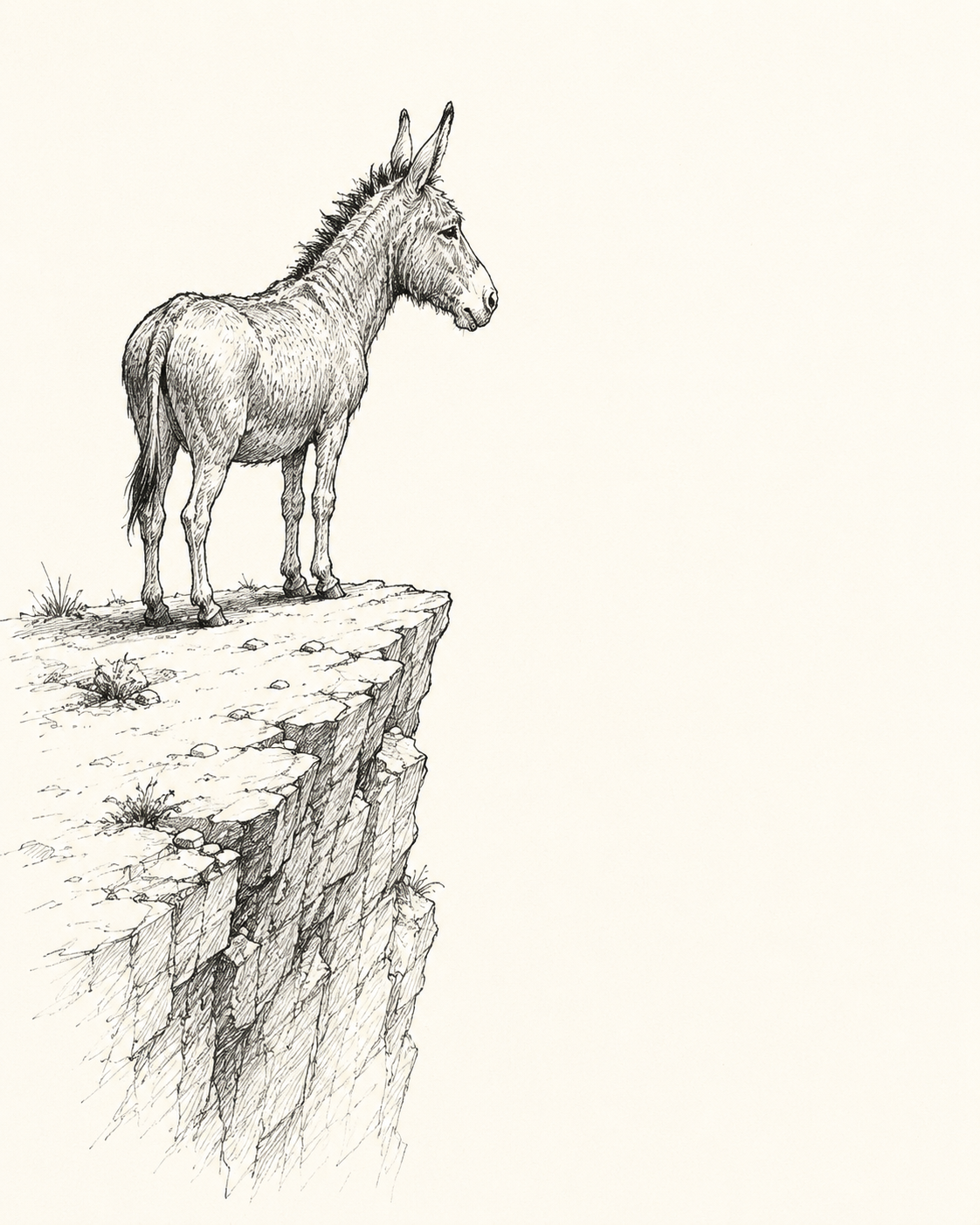
Fig. I. Donkey upon the Edge of the Investigation. Drawn from life, April MMXXVI.
On the twenty-third of April in the year MMXXVI, a man in Bend, Oregon asked an artificial intelligence where to start learning quantum mechanics. The conversation went, unbroken, from F = ma to the open problems of quantum gravity, and by the eleventh of May a paper existed: Paper I, a structural identity and two scaling laws, headed for the arXiv.
It was not the end. Paper I had a loose foundation and an unproven assumption at its core. Paper II corrected the foundation – the averaged observer state is the diagonal of the bulk marginal, not the marginal itself. Paper III confronted the assumption both earlier drafts had stepped around: does the simplified model actually govern the real quantity? It proved that it does – the entropy-replacement theorem – and in doing so made the random-state law unconditional and eliminated the last numerical constant from the proof. The reviewer who forced that final standard was Scholar, run on ChatGPT, with no access to the code and no patience for shortcuts.
This site is the record, presented as a Victorian scientific journal, because a generalist setting out from first principles toward the edge of human knowledge belongs to that tradition. The wrong turns are kept on the page with the right ones; the texture of the correcting is itself the result.
What sits at the end of the walk is small and specific. Two observers of the same quantum object, looking through a noisy irreversible code, disagree by an amount that depends on the structure of the object – and the hard quantum version of that disagreement reduces, provably, to an easy classical one. The dependence has a clean closed form in two cases, and an integer-valued gap between them. The integer is exactly one. Nobody yet knows why.
Entropy Replacement and Complexity-Sensitive Complementarity in Non-Isometric Holographic Codes.
The featured paper, Paper III. Two observers disagree; the hard quantum disagreement reduces, provably, to a classical one; the random case is now unconditional; the integer gap stands.
Pl. I · The Ascent of the Donkey, in Five Figures.
The five-figure ascent from beast to gentleman. Paper I as it first stood, Paper II as it was sharpened, Paper III as it now stands – what each got, what each was missing, and the reviewer who drove the last advance.
The full path of study, drawn as a Victorian railway chart. Thirty-eight stations on six lines, from Newtonian mechanics to the speculative frontier. All routes terminate at the papers.
Pl. II · A Chart of the Curriculum · Six lines, thirty-eight stationsStudy the Map ›IV.
Field Notes · Article § IV
The Notebook, Open. The Wrong Turns, Kept.
Phase memos, work posts, and essays – now including twelve new entries on the road from Paper II to Paper III: the corrected foundation, the covariance that lied, the constant we refused to leave to the machine, and a new plain-English companion, Alice and Bob.
“It is not that the universe has one answer for how much two observers can disagree. It has a hierarchy of answers, indexed by how structured the thing they are looking at is. And we can actually compute the hierarchy.”